

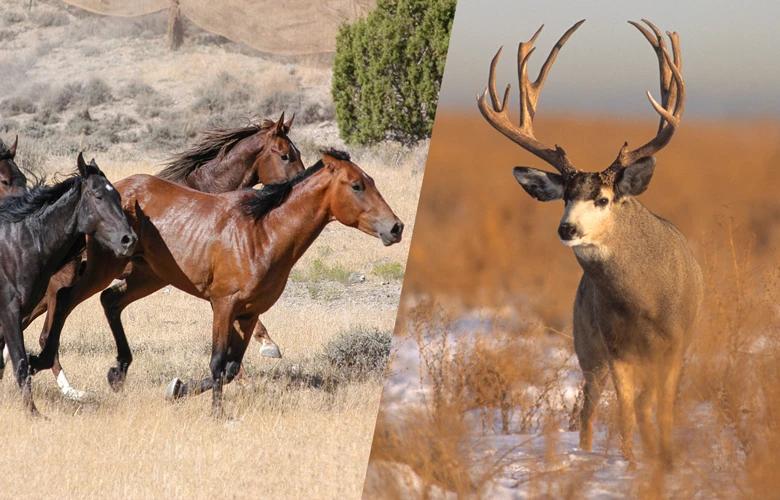
One of the hottest topics in the West... feral horses and their impact on native wildlife
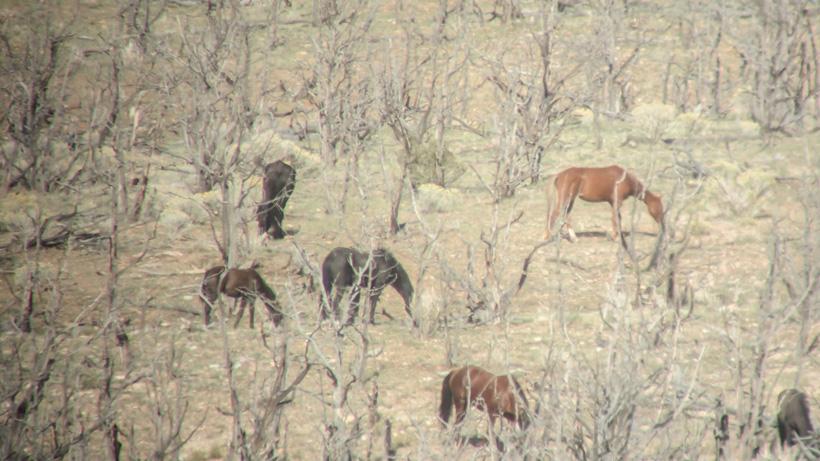
A group of feral horses I glassed up while hunting mule deer.
State | Arizona |
|---|---|
Horses | 268 |
Burros | 13,546 |
Total | 13,814 |
Max. AML | 1,676 |
State | California |
Horses | 3,534 |
Burros | 4,933 |
Total | 8,467 |
Max. AML | 2,236 |
State | Colorado |
Horses | 1,669 |
Burros | 0 |
Total | 1,669 |
Max. AML | 827 |
State | Idaho |
Horses | 564 |
Burros | 0 |
Total | 564 |
Max. AML | 617 |
State | Montana |
Horses | 195 |
Burros | 0 |
Total | 195 |
Max. AML | 120 |
State | Nevada |
Horses | 37,426 |
Burros | 5,146 |
Total | 42,572 |
Max. AML | 12,811 |
State | New Mexico |
Horses | 97 |
Burros | 0 |
Total | 97 |
Max. AML | 83 |
State | Oregon |
Horses | 5,994 |
Burros | 86 |
Total | 6,080 |
Max. AML | 2,700 |
State | Utah |
Horses | 4,611 |
Burros | 232 |
Total | 4,843 |
Max. AML | 1,956 |
State | Wyoming |
Horses | 7,165 |
Burros | 0 |
Total | 7,165 |
Max. AML | 2,566 |
State | Total |
Horses | 61,523 |
Burros | 23,943 |
Total | 85,466 |
Max. AML | 25,592 |
State | Horses | Burros | Total | Max. AML |
|---|---|---|---|---|
Arizona | 268 | 13,546 | 13,814 | 1,676 |
California | 3,534 | 4,933 | 8,467 | 2,236 |
Colorado | 1,669 | 0 | 1,669 | 827 |
Idaho | 564 | 0 | 564 | 617 |
Montana | 195 | 0 | 195 | 120 |
Nevada | 37,426 | 5,146 | 42,572 | 12,811 |
New Mexico | 97 | 0 | 97 | 83 |
Oregon | 5,994 | 86 | 6,080 | 2,700 |
Utah | 4,611 | 232 | 4,843 | 1,956 |
Wyoming | 7,165 | 0 | 7,165 | 2,566 |
Total | 61,523 | 23,943 | 85,466 | 25,592 |
State | Arizona |
|---|---|
Horses | 303 |
Burros | 4,860 |
Total | 5,163 |
Max. AML | 1,676 |
State | California |
Horses | 4,395 |
Burros | 2,946 |
Total | 7,341 |
Max. AML | 2,200 |
State | Colorado |
Horses | 1,415 |
Burros | 0 |
Total | 1,415 |
Max. AML | 812 |
State | Idaho |
Horses | 633 |
Burros | 0 |
Total | 633 |
Max. AML | 617 |
State | Montana |
Horses | 172 |
Burros | 0 |
Total | 172 |
Max. AML | 120 |
State | Nevada |
Horses | 27,599 |
Burros | 2,611 |
Total | 30,210 |
Max. AML | 12,811 |
State | New Mexico |
Horses | 175 |
Burros | 0 |
Total | 175 |
Max. AML | 83 |
State | Oregon |
Horses | 4,327 |
Burros | 49 |
Total | 4,376 |
Max. AML | 2,715 |
State | Utah |
Horses | 4,550 |
Burros | 355 |
Total | 4,905 |
Max. AML | 1,956 |
State | Wyoming |
Horses | 3,760 |
Burros | 0 |
Total | 3,760 |
Max. AML | 3,725 |
State | Total |
Horses | 47,329 |
Burros | 10,821 |
Total | 58,150 |
Max. AML | 26,715 |
State | Horses | Burros | Total | Max. AML |
|---|---|---|---|---|
Arizona | 303 | 4,860 | 5,163 | 1,676 |
California | 4,395 | 2,946 | 7,341 | 2,200 |
Colorado | 1,415 | 0 | 1,415 | 812 |
Idaho | 633 | 0 | 633 | 617 |
Montana | 172 | 0 | 172 | 120 |
Nevada | 27,599 | 2,611 | 30,210 | 12,811 |
New Mexico | 175 | 0 | 175 | 83 |
Oregon | 4,327 | 49 | 4,376 | 2,715 |
Utah | 4,550 | 355 | 4,905 | 1,956 |
Wyoming | 3,760 | 0 | 3,760 | 3,725 |
Total | 47,329 | 10,821 | 58,150 | 26,715 |
Source: Nevada Department of Wildlife
Animal | Mule deer |
|---|---|
AUE | 0.20 |
Animal | Antelope |
AUE | 0.15 |
Animal | Elk |
AUE | 0.60 |
Animal | Bighorn sheep |
AUE | 0.20 |
Animal | Moose |
AUE | 1.00 |
Animal | Mountain goat |
AUE | 0.15 |
Animal | Horse |
AUE | 1.25 |
Animal | Burro |
AUE | 0.75 |
Animal | Cow |
AUE | 1.00 |
Animal | AUE |
|---|---|
Mule deer | 0.20 |
Antelope | 0.15 |
Elk | 0.60 |
Bighorn sheep | 0.20 |
Moose | 1.00 |
Mountain goat | 0.15 |
Horse | 1.25 |
Burro | 0.75 |
Cow | 1.00 |
Fiscal Year | 2025 |
|---|---|
Horses | 6,199 |
Burros | 1,654 |
Total | 7,853 |
Fiscal Year | 2024 |
Horses | 13,154 |
Burros | 2,986 |
Total | 16,140 |
Fiscal Year | 2023 |
Horses | 4,430 |
Burros | 905 |
Total | 5,335 |
Fiscal Year | 2022 |
Horses | 16,971 |
Burros | 3,222 |
Total | 20,193 |
Fiscal Year | 2021 |
Horses | 11,748 |
Burros | 1,918 |
Total | 13,666 |
Fiscal Year | 2020 |
Horses | 9,181 |
Burros | 1,643 |
Total | 10,824 |
Fiscal Year | 2019 |
Horses | 6,126 |
Burros | 1,853* |
Total | 7,979 |
Fiscal Year | 2018 |
Horses | 9,749 |
Burros | 1,723 |
Total | 11,472 |
Fiscal Year | 2017 |
Horses | 3,735 |
Burros | 474 |
Total | 4,209 |
Fiscal Year | 2016 |
Horses | 2,899 |
Burros | 421 |
Total | 3,320 |
Fiscal Year | 2015 |
Horses | 3,093 |
Burros | 726 |
Total | 3,819 |
Fiscal Year | 2014 |
Horses | 1,689 |
Burros | 168 |
Total | 1,857 |
Fiscal Year | 2013 |
Horses | 4,064 |
Burros | 112 |
Total | 4,176 |
Fiscal Year | 2012 |
Horses | 7,242 |
Burros | 1,013 |
Total | 8,255 |
Fiscal Year | Horses | Burros | Total |
|---|---|---|---|
2025 | 6,199 | 1,654 | 7,853 |
2024 | 13,154 | 2,986 | 16,140 |
2023 | 4,430 | 905 | 5,335 |
2022 | 16,971 | 3,222 | 20,193 |
2021 | 11,748 | 1,918 | 13,666 |
2020 | 9,181 | 1,643 | 10,824 |
2019 | 6,126 | 1,853* | 7,979 |
2018 | 9,749 | 1,723 | 11,472 |
2017 | 3,735 | 474 | 4,209 |
2016 | 2,899 | 421 | 3,320 |
2015 | 3,093 | 726 | 3,819 |
2014 | 1,689 | 168 | 1,857 |
2013 | 4,064 | 112 | 4,176 |
2012 | 7,242 | 1,013 | 8,255 |
Feral horses and burros are a hot topic in the West. It's an issue that environmentalists, ranchers, Bureau of Land Management (BLM) officials, and hunters can never agree on. The BLM manages, protects, and controls feral horses and burros under the authority of the 1971 Wild Free-Roaming Horses and Burros Act. This law authorizes the BLM to remove excess feral horses and burros to sustain the health and productivity of the public lands. The BLM also manages the nation’s public lands for multiple uses in accordance with the 1976 Federal Land Policy and Management Act. The BLM manages feral horses and burros as part of this multiple-use mandate.
Feral horses and burros have virtually no natural predators, and "herds can increase at a rate of up to 20% annually, doubling in size in just 4 to 5 years," according to the BLM Horse and Burro Program.
According to the BLM, there are an estimated 61,523 feral horses and 23,943 burros on BLM-managed rangelands in 10 Western states as of March 1, 2026. These populations directly impact mule deer, elk, and other wildlife through both habitat and water. So keep in mind that the total number of feral horses and burros across the West is higher, since these reports only track horses and burros on BLM-managed rangelands.
Since 2012, it's apparent that the feral horse and burro population is growing at an alarming rate. From 2012 to 2026, the population of feral horses and burros across all 10 states has grown 129%, and the maximum appropriate management level (AML) is approximately 26,715. The number of feral horses and burros exceeds the AML by 59,874!
The current population levels are a major issue for big game and other wildlife for several reasons, most notably competition for water. While feral horses compete with wildlife for feed, the long-term drought has reduced water availability across many western states, and water sources will be heavily impacted if heavy rains do not come this spring and summer. Hunters who use water holes as blind locations for hunting may see continued feral horse encounters. The BLM says that the current estimated population far exceeds the number that they have determined can exist in balance with other public rangeland resources.
Source: BLM Horse and Burro Program Data
Source: BLM Horse and Burro Program Data
Source: BLM Horse and Burro Program Data
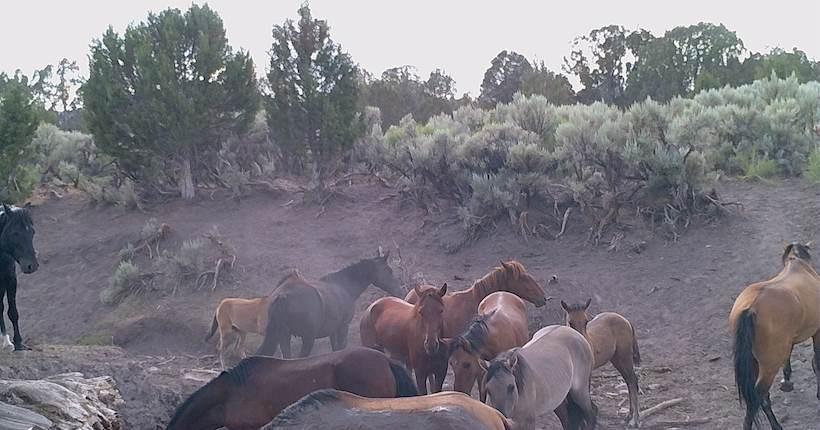
If you've hunted in Nevada, you have likely run into a few herds of feral horses. I can't begin to count the number of times I've been hunting in Nevada and have seen an abundance of feral horses. I have even witnessed feral horses surrounding a water source for the entire day. As I sat at my glassing location, I could keep tabs on this waterhole. I watched the same mule deer buck try to access the water multiple times throughout the day, but would not get access to water due to the horses.
Nevada's mule deer populations are at an all-time low, while feral horse and burro populations in Nevada are at an all-time high. Could that be related?
From 2015 to 2026, the total feral horse and burro population in Nevada increased by 40.9%.
Source: Nevada Department of Wildlife
Source: Nevada Department of Wildlife & BLM Horse and Burro Program Data
While the Nevada feral horse and burro population on BLM lands increased by 40.9% from 2015 to 2026, the statewide mule deer population decreased by 27.3%.
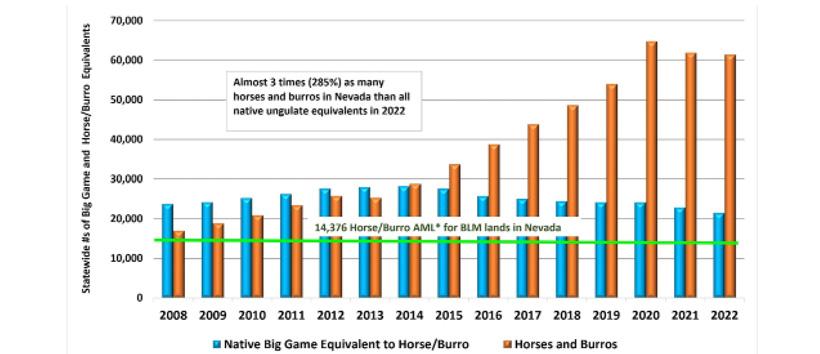
The figure below compares the numbers of all Nevada’s native big-game animal equivalents to horses and burros in terms of biomass, 2008-2022. It’s very alarming!
Figure 1. Statewide comparison 2008-2022 of the estimated number of free-roaming horses and burros to the biomass equivalent of all native big game animals in Nevada.
Feral equids are disproportionately larger than Nevada’s native ungulates (elk, mule deer, bighorn sheep, and pronghorn antelope) because they never evolved in synchronicity with Nevada ecosystems that exist today. The graph uses the best available values and rates of body weight, forage consumption, and water intake among the 2 groups to compare “apples to apples” of the forage and water use of the equivalent number of native ungulates to that of a horse/burro. The green horizontal line is the BLM’s statewide Appropriate Management Level (AML) if horses and burros were managed in a “thriving natural ecological balance with the habitat” as required by The Wild Free-Roaming Horses and Burros Act of 1971 (Public Law 92-195).
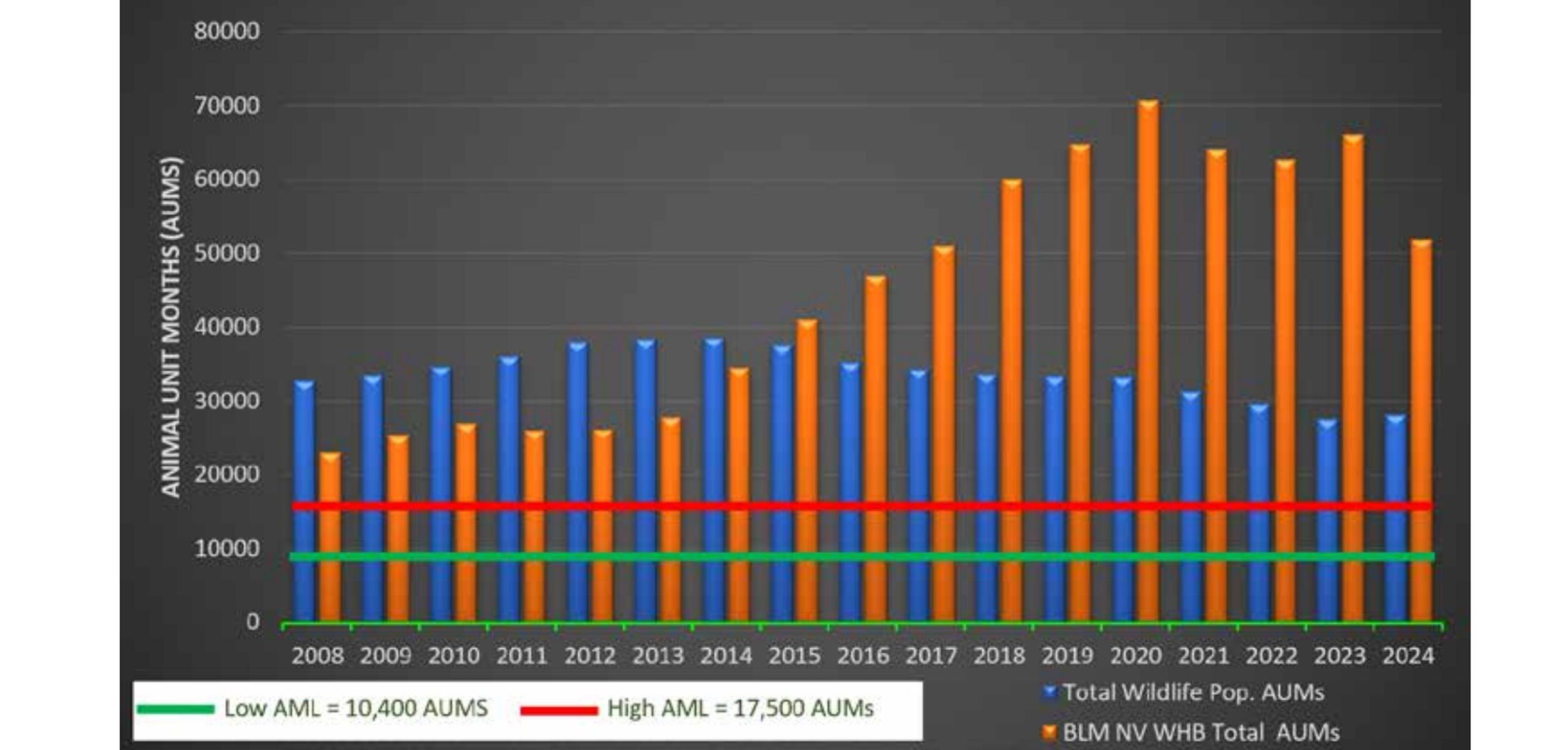
The graph above compares Nevada wildlife species with Nevada feral horses and burros AUMs. The AUM estimates are based on FY2024 wildlife and feral horses and burros populations in Nevada. The horizontal green and red lines represent the low and high AML ranges, respectively. The blue vertical columns represent the total wildlife AUMs in Nevada, while the orange columns represent the AUMs of feral horses and burros in Nevada.
An animal unit month (AUM) is the amount of forage a 1,000 lb cow and her calf up to 6 months of age consume. It can be expressed as an air-dry or oven-dry metric, although many professionals use the oven-dry metric of approximately 800 lbs.
To make comparisons across different species of animals possible, animal unit equivalents (AUEs) have been developed. Although most literature sources state horses are 1.25 AUEs (meaning that one horse eats 1.25 times as much as one 1,000 lb cow and her calf up to 6 months of age), BLM has consistently used 1.0 AUMs for horses in their forage calculations.
A mule deer, for example, is 0.2 AUEs, so five mule deer would eat what one cow eats in a month.
AUMs do not account for any type of forage preferences or availability; it is simply a total forage amount.
AUMs for Nevada’s native wildlife exceeded feral horses and burros AUMs until 2015. Since 2015, horse and burro AUMs have exceeded native wildlife and high AML. These AUMs are for HMAs in Nevada (including the HMAs that are physically in Nevada but administered by BLM California). Low AML is 10,400 AUMs, and high AML is 17,500 AUMs. It should be noted that AML has varied slightly over the years but has not changed substantially.
In Nevada, seven counties (Elko, Eureka, Humboldt, Lander, Pershing, White Pine, and Lincoln) have issued emergency declarations/resolutions citing the impacts from feral horses.
In a 2016 article, the Elko Daily Free Press covered a story on the reduction of cattle grazing allotments in Nevada due to an overpopulation of feral horses. Basically, the BLM is going to close some of the cattle grazing allotments in order to provide feed for feral horses. Elko County Commissioner Demar Dahl said Tim Smith of the state BLM office told him most of the allotments would be completely closed to grazing, but a few of them could be left open with 50 percent reductions in grazing levels. At this point, removing more of the horses is not an option, and may not happen until later this fall.
Source: BLM Horse and Burro Program Data
Greg Deimel, BLM Public Information Officer, said the BLM has gathered 1,750 horses in the region since 2011 and it is still overpopulated by “thousands” of horses. Getting the population down to the minimum authorized level would involve removing over 1,000 horses from each of the four herd management areas, he said.
Julie Gleason, a member of the local Resource Advisory Council to the BLM said, “The only solution is to remove horses from the ranges, but every time we get something going, the environmentalists stop us.”
“It is an absolute disgrace that the misguided whims of environmentalists are given precedence over the livelihoods of our ranching families,” said Elko County Commissioner Rex Steninger.
According to the BLM, most western rangelands produce only a few hundred pounds of vegetation per acre. A feral horse can eat their weight in dry forage every month. In many parts of Nevada, it can take 20 or more acres to feed one feral horse for a month!
* Includes two mules
With no natural predators, herd numbers grow exponentially. The National Academy of Sciences has reported that no highly effective fertility-control methods are currently available. In 2015, the BLM began investing $11 million in research to find effective methods to neuter and spay feral horses and develop longer-lasting contraceptive vaccines. With an additional 48,000 feral horses and burros in off-range (unadopted or unsold) holding facilities at a cost of over $49 million per year... it is easy to see that a solution to the increasing population needs to be found, especially because the total capacity of all BLM off-range holding facilities is 58,519 animals...
Will we see a gradual decline of mule deer and elk populations in some areas due to the increased pressure from these non-native feral horses? What will happen to our native wildlife in a severe drought year when feral horses and burros are competing for the already fragile water sources?
Hopefully, putting the problem in the spotlight will provide more incentive for the BLM to make progress toward a solution. I'd love to hear your thoughts on this issue.
This article was originally published on April 30, 2016, and has been updated with more information.