

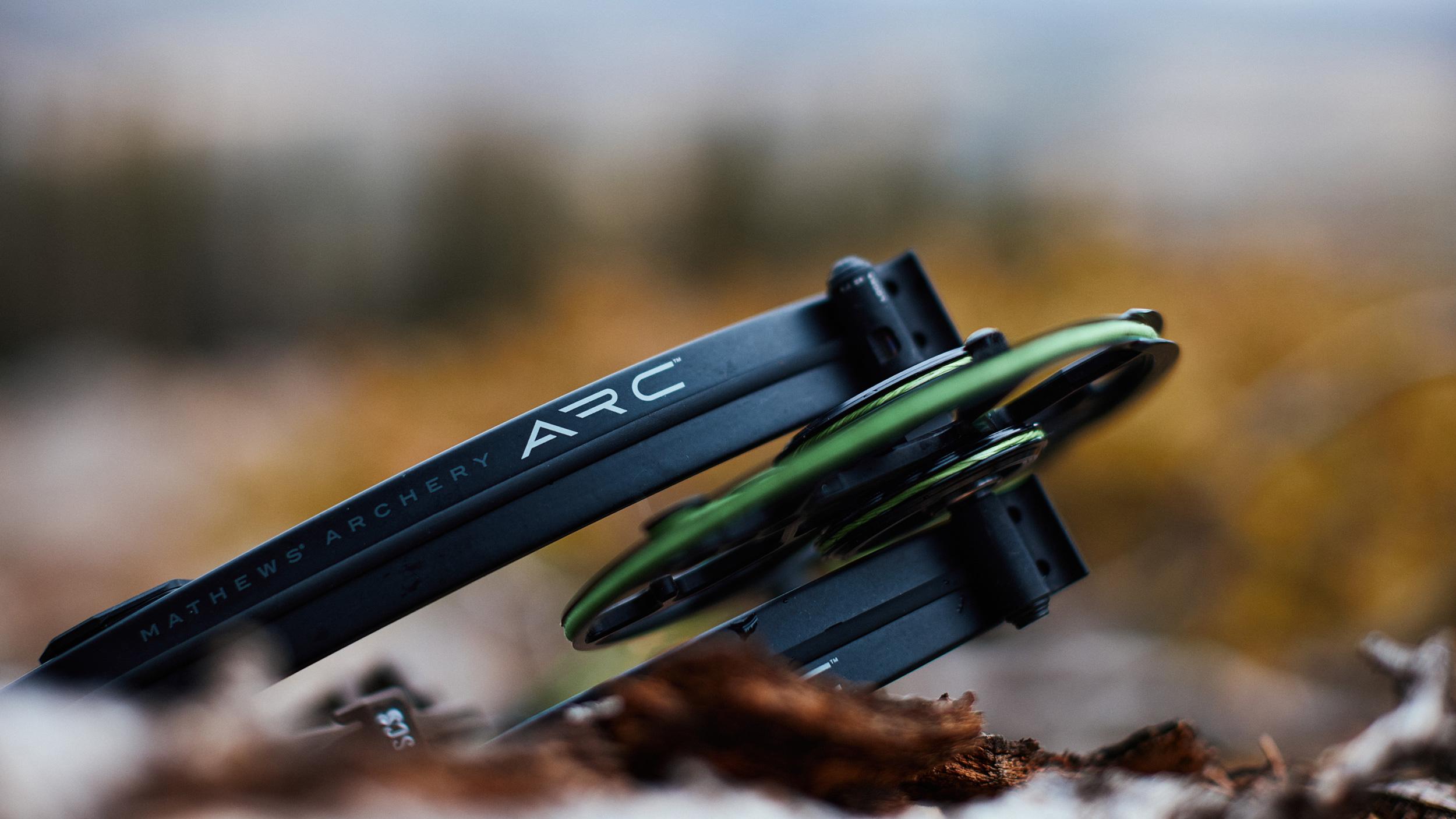
Insights of the brand new Mathews ARC after hunting with the bow the past three months and why you should head to your local pro shop to check out this hunting bow for 2026
Mathews ARC 30 |
Mathews ARC 34 |
Brace Height |
6” |
6.5” |
IBO Rating |
Up to 348 fps |
Up to 343 fps |
Axle To Axle |
30” |
34” |
Draw Weight |
55, 60, 65, 70, 75 & 80 |
55, 60, 65, 70, 75 & 80 |
Draw Lengths |
25” to 30.5” |
26.5” to 32” |
Let-Off |
80 or 85% |
80 or 85% |
Physical Weight |
3.99 lbs |
4.3 lbs |
Cam |
SWX-2 |
SWX-2 |
MSRP |
$1,459.00 |
$1,569.00 |
Mathews ARC 30 | Mathews ARC 34 | |
Brace Height | 6” | 6.5” |
IBO Rating | Up to 348 fps | Up to 343 fps |
Axle To Axle | 30” | 34” |
Draw Weight | 55, 60, 65, 70, 75 & 80 | 55, 60, 65, 70, 75 & 80 |
Draw Lengths | 25” to 30.5” | 26.5” to 32” |
Let-Off | 80 or 85% | 80 or 85% |
Physical Weight | 3.99 lbs | 4.3 lbs |
Cam | SWX-2 | SWX-2 |
MSRP | $1,459.00 | $1,569.00 |
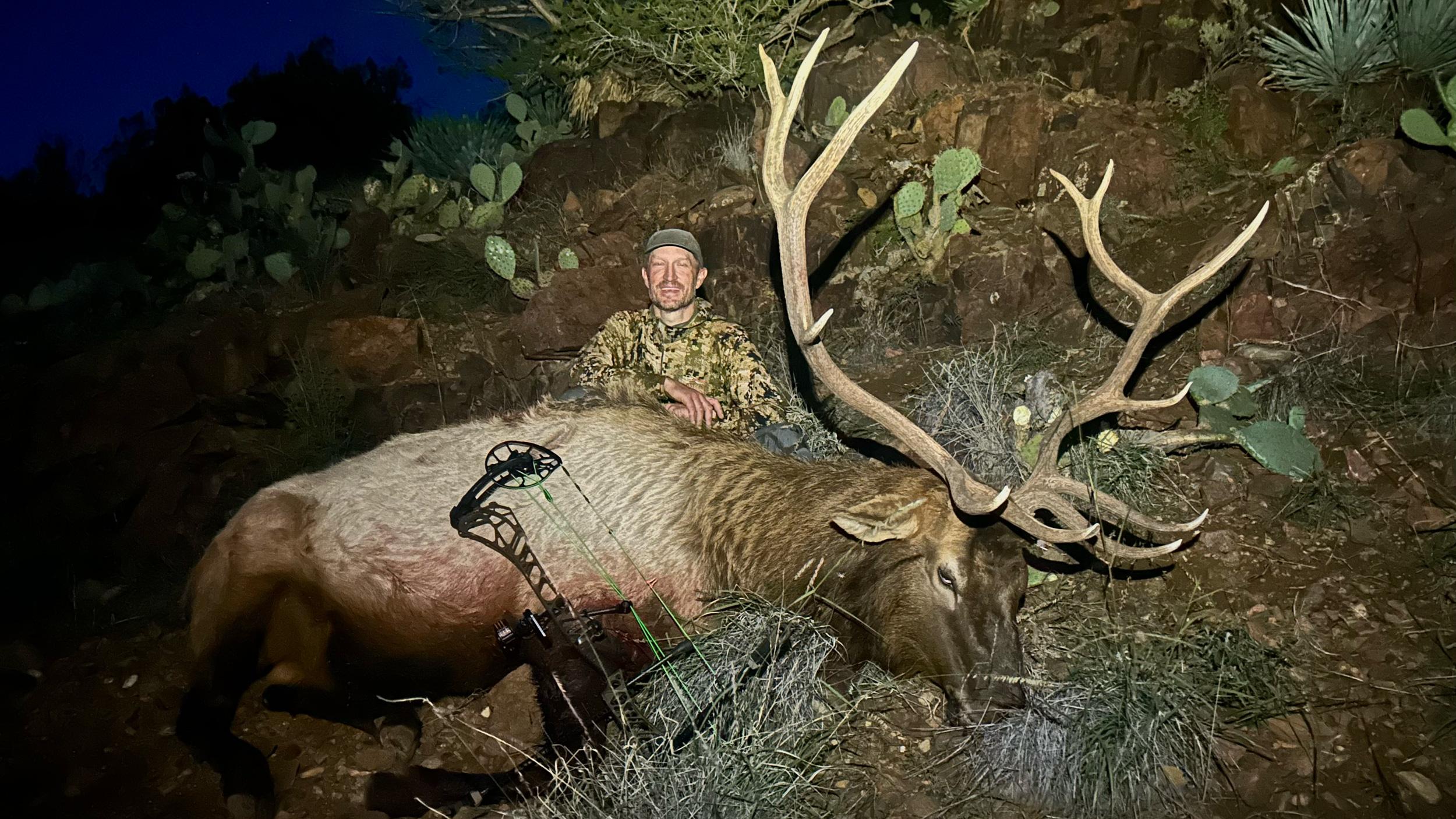
The late-season bull elk I recently took in Arizona with the Mathews ARC.
When it comes to hunting bows, there’s a variety of features that you might be chasing. Some bowhunters are more interested in speed, while others may be more focused on how smoothly it draws, how quiet and dead in the hand it might be, or perhaps how well it aims and delivers an accurate arrow at extended yardage. Many bowhunters are looking for a bow that is as lightweight as possible, and that is a major deciding factor in purchasing. It’s easy to say that every flagship bow on the market delivers all of those, but the reality is that depending on what you value most, there are some bows that fit your style better than others.
As a western big game bowhunter with my specs, I would suggest that my priorities in a hunting bow would look something like this: tunability (holds a tune), accuracy, speed, smooth draw, quiet on the shot, vibration, and overall weight. Now, tunability and accuracy are somewhat related, and could be interchanged, but the point is that a bow that is easy to tune and holds its tune is also often an accurate bow. There are other specs of a bow that I think produce a more accurate bow, which I will touch on, but the tuneability of a bow and how accurate the bow is are closely related. With that, I’ll dive into why I think the 2026 Mathews Archery ARC 34 is quickly becoming my favorite bow I’ve ever owned. I’ve spent a few months with this bow, both at the range and in the field, and here’s the full breakdown.
If you're ever in Las Vegas, be sure to stop by to check out the Mathews ARC in person. We recently opened our own bow shop, and we have plenty of Mathews ARC bows for you to shoot and purchase.
The Arc 34 is 34 inches axle-to-axle (ATA). That’s the longest axle-to-axis hunting bow that Mathews has had in their hunting lineup in a number of years. Previously, one of the best hunting bows I have owned was the Halon X, which was 35” ata. That bow seemed so easy for me to shoot well, which I believe was largely due to the overall length. The analogy of holding a yardstick or a broom handle in the middle with your bow hand is often used, and I’ll use it again because I think it translates well. A yardstick can be rotated relatively easily in your bowhand from left to right, while a broom handle is much harder to manipulate. The added length, being farther from your grip, makes it harder to move, i.e., it resists torque. This is precisely why, if you were to attend a pro-level shoot of any kind, you’ll see those professionals toeing the line with bows that are mostly 36” to 40” in ATA. If a shorter bow were more accurate, you can bet the pros would be using them. That said, hunting isn’t target shooting and has its own demands. In hunting situations, you have to carry the bow and shoot it in real-world environments where there is often vegetation, a variety of angles, and sometimes you have to manipulate your form to get into a position to shoot. Over the years, I think that somewhere between 33” -35” is the range that works best for me, and the ARC 34” lands right in the sweetspot. It’s long enough that it provides an incredibly stable hold, while being short enough that I haven’t had it get in the way while I am stalking or moving through western landscapes. Would it be the best choice for folks who hunt from a treestand or in a ground blind? It probably would not be, but for antelope, mule deer, elk, and most other western big game, I believe it’s the best of both worlds.
I already noted that accuracy and tunability are closely related, so let's look at the features of the ARC that make it so easy to tune and shoot.
For starters, the Limb Shift Technology makes tuning extremely easy. The limb shift tech allows you to micro-adjust limb position without a press by turning an Allen key in the limb tip axle. This corrects your left/right arrow flight by shifting the limb in or out to adjust cam lean. In essence, you set your rest at approximately 13/16’s, shoot the arrow through paper, and can turn the internal axle screw(s) left or right to correct the arrow flight to tune out your left or right paper tears. One thing I really like about the limb shift feature is that it's micro-tunable and I don’t have to rely on moving my rest alone, or at all. I’ve used the limb shift feature to paper tune, then bare shaft tune, and even tune my broadheads at distance to get what I feel is an incredibly precise tune on the bow. It’s also a major time saver due to the fact that a press is not required.
Draw length is arguably the most critical factor in how accurately you will shoot any given bow. In addition, draw weight and holding weight also contribute to your accuracy. If you are over-bowed it can be hard to draw and hold steady, and depending on your shooting style you may require a bit of extra holding weight to pull against to steady your aim. The ARC bows utilize the Switchweight X mods. The mods are available in a variety of draw lengths in half inch increments from 26.5” to 32”. The SWX mods are also available in two let-off options, 85% and 80%. The 85% mods obviously allow the bowhunter to hold less weight at full draw, which can be helpful in a hunting situation where you might have to remain at full draw before an animal offers you a shot. My preference has been the 80% lower let-off, because I tend to pull into the shot, and the added poundage at full draw helps steady my pin as I pull. The SWX mods also allow you to change draw weights by switching them out. You can choose from 55, 60, 65, 70, 75, and even 80-pound draw mods. This feature is nice because you never have to unscrew the limb bolts to lower the poundage. You choose the mods for your desired draw weight and leave the limb bolts turned all the way in where they are the most efficient. One final note on the SWX mods and ARC 34; the bow is long enough ATA that I think it will be a great cross-over hunting and target bow for a lot of people. For about $69, you can buy a set of 60-pound mods, which are common for target archery and go back and forth for hunting and target archery.
The new ARC bows do have a new cam, called the SWX-2. The new cam feels very similar to me to last year's Lift X 33. It’s a smooth drawing bow, with no notable humps or drops into the back wall. I really like the draw cycle of the new cam. The SWX-2 cam does have a new parameter weight that further reduces felt recoil and retains speed. I loved the feel of the SWX cam on the Lift and Lift X, the SWX-2 cam improves upon those while still providing a smooth drawing experience, even at higher poundage.
Overall, the tuning features make the ARC relatively easy to tune and work on. Do I wish that I could manipulate the draw length in ¼” increments or have some mechanism to more easily adjust the cam sync? Yes, I do, but those would also come at a cost of less efficiency. The cam sync can take some time to adjust to perfection in some cases, and the draw length might need to be adjusted by twisting/untwisting cables or the string if you land between a whole number and a half, but it’s very manageable. When I put the time into setting the bow to my exact liking, I will say that it seems to hold a tune well.
When I pulled the ARC 34 out of the box for the first time, I noticed that the riser looked different from last year's Lift X. The ARC riser has reinforced sections at the top and bottom, which add rigidity where it matters. The physical weight of the ARC is about 4.3 lbs, while the Lift X 33 was 4.26 lbs. So Mathews has made the ARC 34 longer and more rigid where needed, while adding only 0.04 lb to the overall weight. As a backpack bowhunter, it’s a dream come true. It’s more stable in the hand, a bit faster, as quiet, and weighs almost the exact same as last year's bow. Also, one last note on the riser, Mathews has machined the Silent Connect System into the riser of the ARC bows. This system allows treestand hunters to easily loop a rope over that portion of the riser to hoist it and lower it from their stand. It’s not a complete game changer for most western big game hunters, but you never know when I might hang a treestand to hunt elk or muleys over a wallow, and it’s a nice perk to have it already incorporated into the riser.
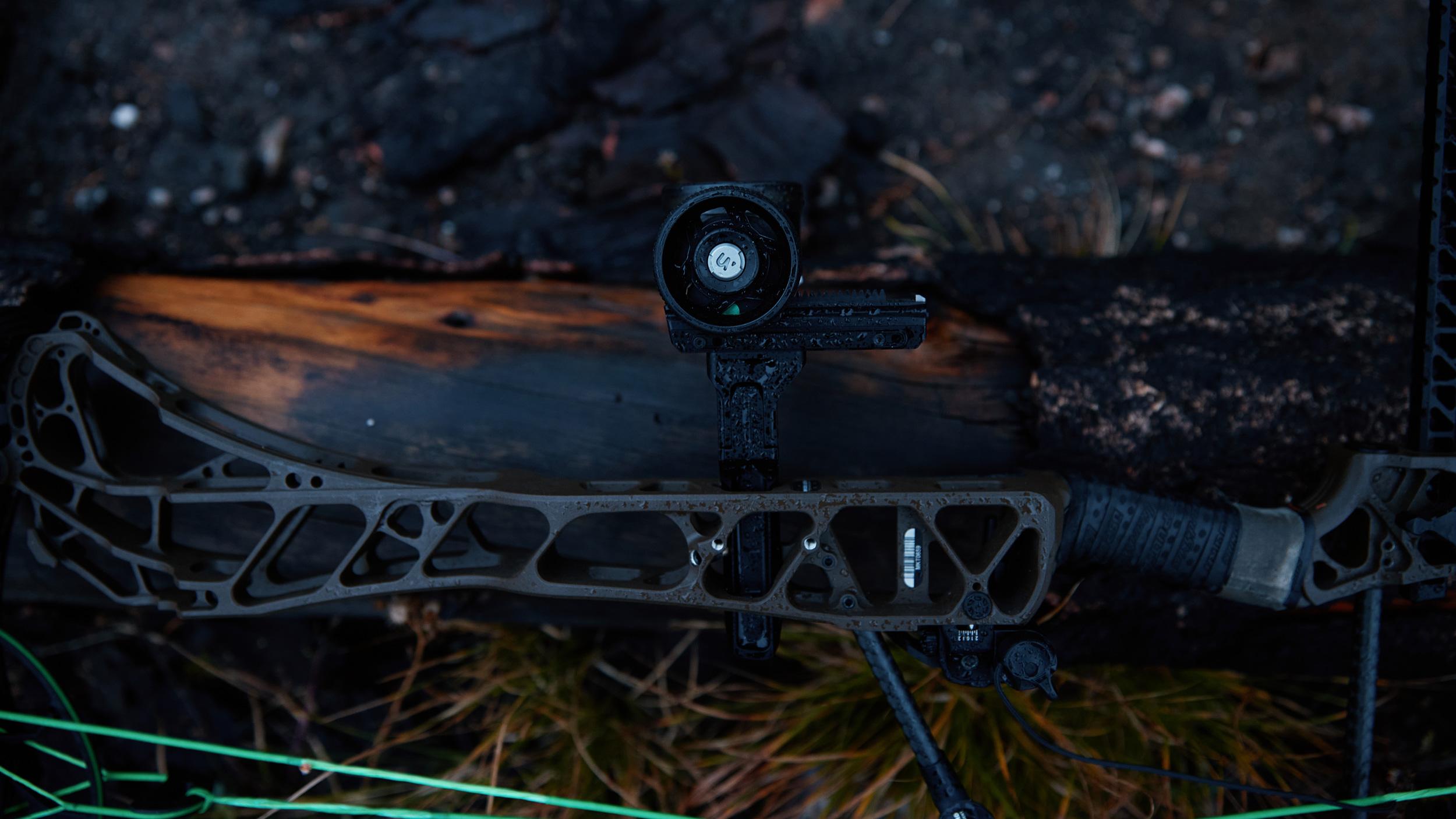
The ARC continues to incorporate the bridgelock design for dovetail sights, Mathews stabilizers, and it also has the machined dovetail receiver for rests like the Mathews Archery QAD Ultra Rest HDX or even the new Hamskea R7. The Bridgelock sight receiver makes your entire system more streamlined, balanced, and lighter weight. I’ve grown to really like the Bridgelock system for both sights and stabilizers. They're easier to remove while traveling or hiking, and they provide a more secure, solid mounting system.
Mathews has continued down the path of producing a quieter bow with less recoil year after year. The ARC has a new limb cup design that reduces weight, adds stability, and with a redesigned limb assembly, the ARC creates a perfectly parallel limb path that decreases shot vibration and increases efficiency.
They still utilize a harmonic dampener in the bottom portion of the riser, as well as their bridgelock stabilizers, should you decide to purchase those along with the bow. Those harmonic dampers soak up sound and vibration. The ARC limbs continue with the rubber dampener that is seated between each set of limbs. The rubber dampener between each limb further kills sound and post-shot vibration. In addition, the ARC has a rubber string stop that prevents the string from excessive follow-through and oscillation. Just the parallel design of the limbs alone cancels a lot of vibration after the shot.
In all, the ARC is as quiet in my opinion as the Lift X, and that bow was the quietest bow I’d ever owned. For me, there may be ever so slightly more feedback than the Lift X 33 with the ARC 34, but it’s still one of the most dead in the hand shooting bows on the market. Mathews has sound and post shot vibration figured out, the ARC is truly a pleasure and a lot of fun to shoot. The ARC is the quietest bow on the market compared to other models.
What makes a bow accurate? That is somewhat of a loaded question, because the reality is that the person holding it is most likely the biggest factor, but the ARC 34 does have some features that I think can help you be more accurate, no matter your skill level. For starters, the ATA length and wide limb platform provides a very stable platform. Secondly, the ARC is easy to tune for fantastic arrow flight, and the draw weight, let-off, and draw length is easy to tune to each individual bowhunter via the interchangeable mods. The string angle also offers a comfortable anchor, where I haven’t had to duck my head into the string to find my anchor point. The 6.5” brace height is a good mix of being long enough that it’s forgiving for a hunting bow, but it also helps to generate more power stroke and feet per second (FPS). Truly, the ARC 34 is an easy bow to shoot. Some bows I have owned in the past just felt like I had to work harder to aim and release an accurate arrow; this isn’t one of them. The ARC 34 aims and holds easier than others I’ve owned, and there really isn’t anything more enjoyable than your arrow hitting directly behind the pin.
I won’t spend a ton of time here, but the IBO of the ARC 34 is up to 343 FPS. That’s tested with a 30” draw length, 70# draw weight, and a 350-grain arrow, with next to nothing on the string. Those specs aren’t realistic for a hunting bow. While I haven’t tested a variety of arrow weights, I can report that with my bow completely set up with a peep, tied in nocking points, and a D-loop, I am consistently getting 287 FPS with a 480-grain finished arrow.
My personal specs for my ARC 34 are 30.25” Draw Length and 70.4 pounds. That 287 FPS number is in my personal wheelhouse for what I am looking for in a hunting arrow. It’s fast enough that my pin gaps are relatively tight and I can still reach out to 100-plus yards for practice. The fact that I am able to achieve that with a 480-grain arrow is impressive to say the least. That provides me approximately 87.81 foot-pounds of kinetic energy, which is more than enough to hunt almost any animal in the world. I witnessed firsthand the penetration potential of a late-season bull elk last month in Arizona, and I was thrilled with the results.
Along with the new ARC bows, Mathews has released some accessories that I think are worth discussing. Most western bowhunters are shooting a back bar at this point, and for 2026, Mathews has improved their backbar bracket. The new version, called the Integrated Bridge-Lock V-Bar, slides through the back of the riser, and you thread a tension screw through the riser to secure the backbar bracket just inside the riser. This is a small change, but it does secure the bracket much better than the previous model, which was always something that I had to regularly check to make sure it was in the same position and bolted down well. The new bracket is also lighter. It’s one less thing I have to think about going forward.
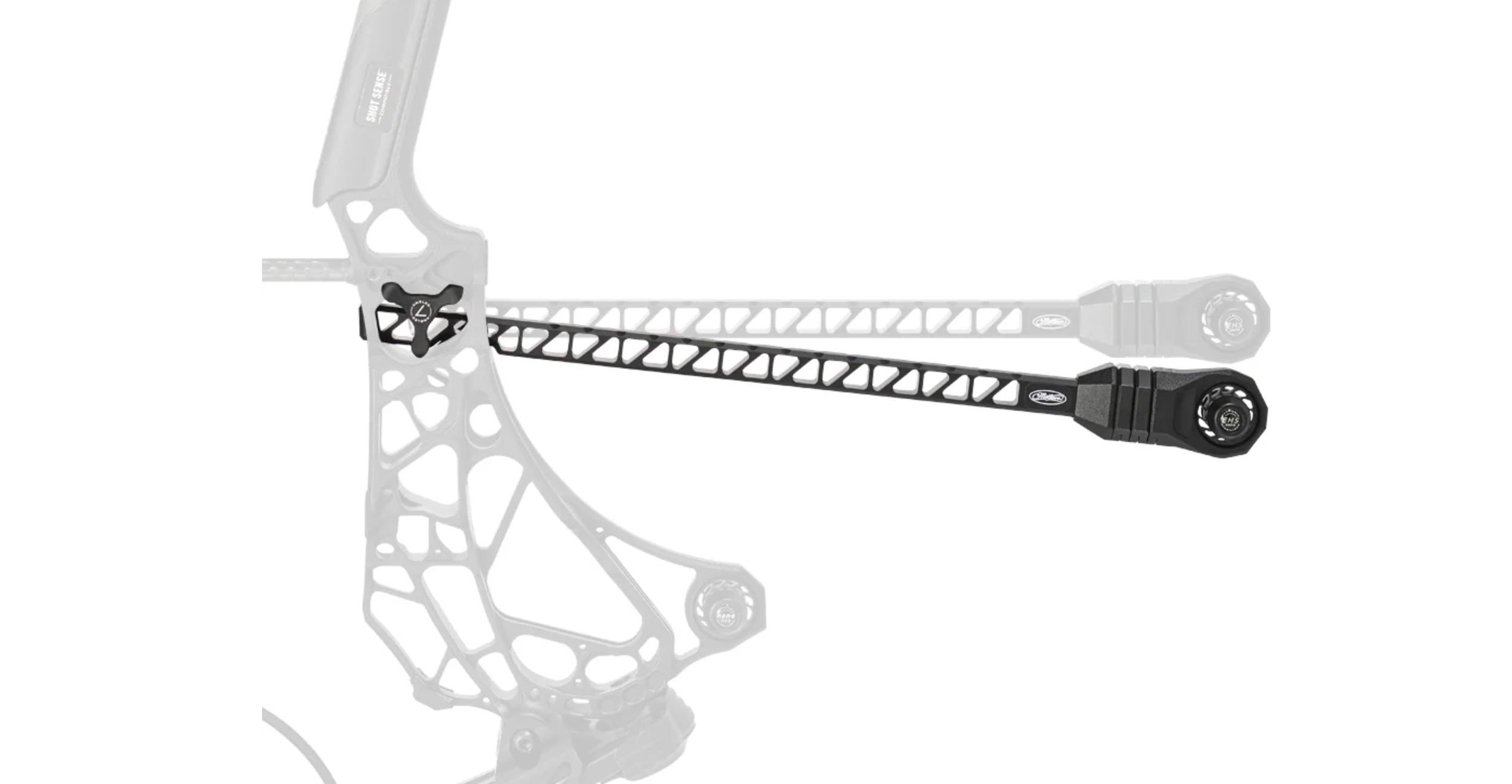
I already noted that I like the Mathews Bridgelock stabilizers, but prior to this year, they were only available in straight mount versions. New for this year, Mathews is making Bridgelock stabilizers in 10”, 12”, and 15” lengths that have a 7-degree down angle called the Angled Bridge-Lock Stabilizer. They can still be mounted and shot in a straight configuration, but the notch in the bottom of the new bars allows you to drop the angle of the bar in the riser if you’d like. Some people like an angled down front stabilizer. It can help to level out quicker, reduce wobble, or simply offers a more steady aim for some. I’ve tried both, and for my style, I seem to prefer the straight mount, but I’m also not one to stop tinkering to see if some small change might help the bow be more accurate. I do appreciate the option on the new stabilizers.
Lastly, the ARC is available in several color combinations. They offer solid-colored risers and limbs in black, earth, Green Ambush, grey, and the new Kodiak Brown. They also offer camo versions in multiple patterns if that’s your flavor. You can even get custom orders with one riser color and different colored limbs. Match grade string and cables can also be ordered in custom colors. Everyone has their personal preference, but a few combos I really like are the Earth riser with Green Ambush or black limbs. The grey with black limbs looks sharp, as does the black riser with the earth color limbs. The bow I got has the new brown riser and black limbs. I think when I pair it with white strings and buckskin or brown serving, it’s going to look incredible, and let’s be honest…a cool-looking bow is just more fun to shoot.
I know, every year we hear that the newly released bow is the best one ever. I’m certain I’ve said it, and I’m going to say it again, sorry! I think the Mathews Archery ARC 34 is the best hunting bow I’ve ever owned.
Is it the best bow for you? It’s hard to say, but I would suggest you get to a local pro shop and shoot one if you are in the market for a new bow. For me, a 34” inch ATA bow that is as fast, tunable, quiet, accurate, and fun to shoot hasn’t existed before now. It’s a really nice bow, and every time I pick it up to take a trip to my local range to shoot, it puts a smile on my face. The MSRP for the ARC 34 is $1,569 which admittedly is not cheap, but if shooting a bow and arrow and adventure bowhunting is something you live for….it’s completely worth it.